G A N Z E E R . T O D A Y

“In 1378, two years before Poggio's birth, the seething resentment of these miserable day laborers, the populo minuto, had boiled over into a full-scale bloody revolt. Gangs of artisans ran through the streets, crying, 'Long live the people and the crafts!' and the uprising briefly toppled the ruling families and installed a democratic government. But the old order was quickly restored, and with it a regime determined to maintain the power of the guilds and the leading families.”

First time for me to hear of this revolt. Also from Stephen Greenblatt's THE SWERVE, which covers so much ground.

“Poggio's way of fashioning letters was a move away from the intricately interwoven and angular writing known as Gothic hand. The demand for more open, legible handwriting had already been voiced earlier in the century by Petrarch (1304-1374). Petrarch complained that the writing then in use in most manuscripts often made it extremely difficult to decipher the text, 'as though it had been designed,' he noted, 'for something other than reading.'”

Extremely my shit on so many levels this book.

#reads

“Ancient Greeks and Romans did not share our idealization of isolated geniuses, working alone to think through the knottiest problems.”

From Stephen Greenblatt's riveting book, THE SWERVE: HOW THE WORLD BECAME MODERN.

“Such scenes—Descartes in his secret retreat, calling everything into questions, or the excommunicated Spinoza quietly reasoning to himself while grinding lenses—would eventually become our dominant emblem of the life of the mind. But this vision of proper intellectual pursuits rested on a profound shift in cultural prestige, one that began with the early Christian hermits who deliberately withdrew from whatever it was that pagans valued: St. Anthony (250-356) in the desert or St. Symeon Stylites (390-459) perched on his column. Such figures, modern scholars have shown, characteristically had in fact bands of followers, and though they lived apart, they often played a significant role in the life of large communities. But the dominant cultural image that they fashioned—or that came to be fashioned around them—was of radical isolation.”

I maintain that the very notion of the “isolated genius” today—still prominent in contemporary culture—is an absolute fiction. No man is an island, though certain aspects of one's environment or social makeup may drive a person to feel they are an island, but true and genuine absolute islandhood is bound to spell the death of one's creative life.

“Not so the Greeks and Romans. As thinking and writing generally require quiet and a minimum of distraction, their poets and philosophers must have periodically pulled away from the noise and business of the world in order to accomplish what they did.”

The keyword here, being “periodically.”

“But the image that they projected was social. Poets depicted themselves as shepherds singing to other shepherds; philosophers depicted themselves engaged in long conversations, often stretching out over several days. The pulling away from the distractions of the everyday world was figured not as a retreat to the solitary cell but as a quiet exchange of words among friends in a garden.”

House-sitting for friends now, and spotted the book on one of the shelves. Decided to flip through it a few days ago and haven't been able to put it down since.

“The invention of movable type in the fifteenth century changed the scale of production exponentially, but the book in the ancient world was not a rare commodity: a well-trained slave reading a manuscript aloud to a roomful of well-trained scribes could produce masses of text. Over the course of centuries, tens of thousands of books, hundreds of thousands of copies, were made and sold.

“There was a time in the ancient world—a very long time—in which the central cultural problem must have seemed an inexhaustible outpouring of books. Where to put them all? How to organize them on the groaning shelves? How to hold the profusion of knowledge in one's head? The loss of this plentitude would have been virtually inconceivable to anyone living in its midst.”

Call me a pessimist but I kind of foresee an inevitable halt to the plentitude of data (along with “content”) being collectively churned out by present human civilization as well.

“Then, not all at once but with the cumulative force of mass extinction, the whole enterprise came to an end. What looked stable turned out to be fragile, and what had seemed for all time was only for the time being.”

Those who cannot remember the past are condemned to repeat it, after all.

“Starting as early as 300 BCE, the Ptolemaic kings who ruled Alexandria had the inspired idea of luring leading scholars, scientists, and poets to their city by offering them life appointments at the Museum, with handsome salaries, tax exemptions, free food and lodging, and the almost limitless resources of the library.”

Take me back to ancient Alexandria please.

“The recipients of this largesse established remarkably high intellectual standards. Euclid developed his geometry in Alexandria; Archimedes discovered pi and laid the foundation for calculus; Eratosthenes posited that the Earth was round and calculated its circumference to within 1 percent; Galen revolutionized medicine. Alexandrian astronomers postulated a heliocentric universe; geometers deduced that the length of a year was 365 ¼ days and proposed adding a “leap day” every fourth year; geographers speculated that it would be possible to reach India by sailing from Spain; engineers developed hydraulics and pneumatics; anatomists first understood clearly that the brain and the nervous system were a unit, studied the function of the heart and the digestive system, and conducted experiments in nutrition. The level of achievement was staggering.”

Let us remind ourselves that what inevitably consigned all that achievement to oblivion and brought it all down was the prejudice exercised by the Roman Empire—some 270 years after Ptolemaic rule—against one of its minority groups/cults concentrated in the eastern provinces, and—as the story goes—charging one member of that minority with treason against the empire before executing him.

#reads

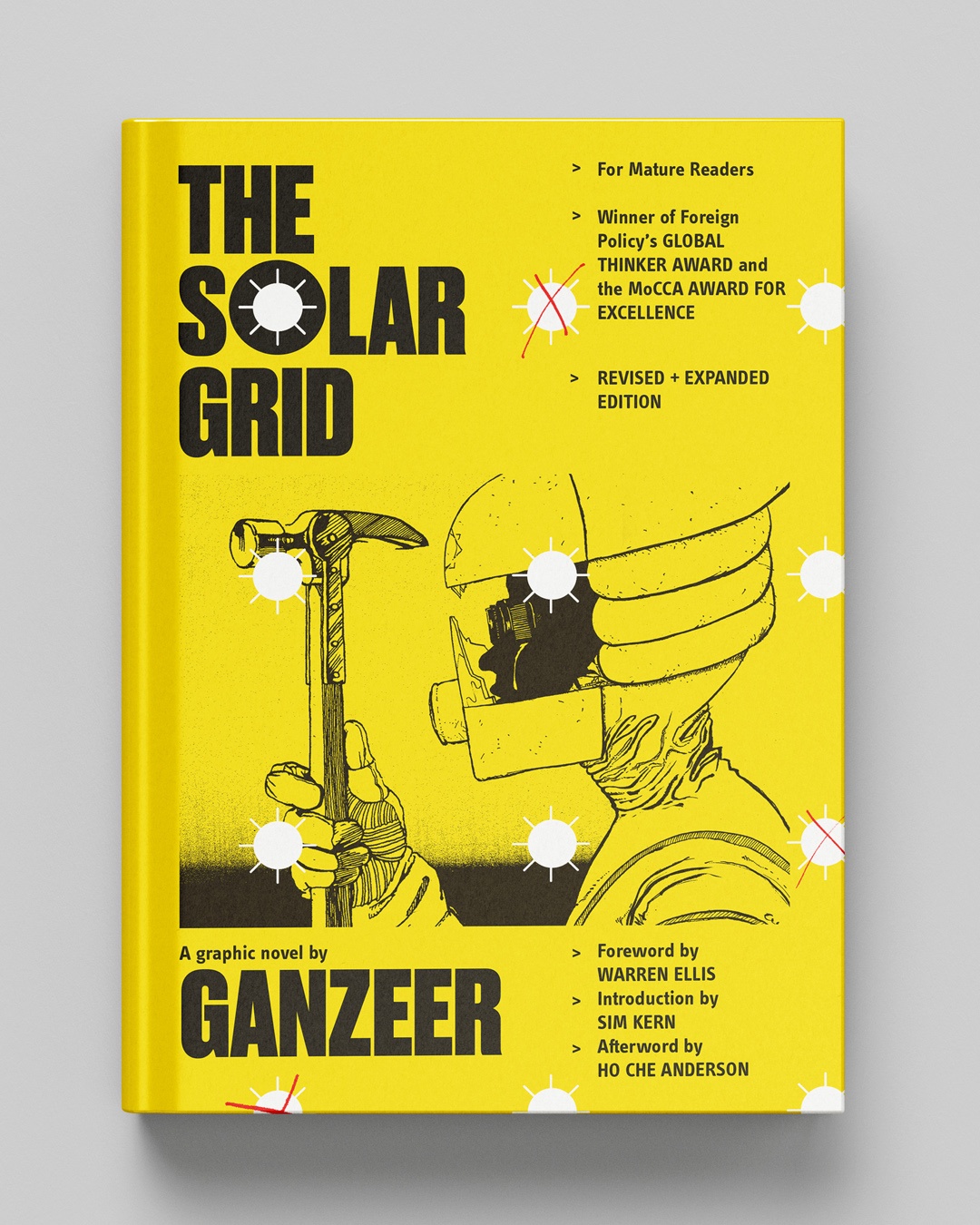
Upon reading what I felt was an absolute throwaway book—THE COMMONSENSE OF NUDISM by George Riley Scott—an idea for a most unusual sort-of-sequel to THE SOLAR GRID made its way into my mind. Now, THE SOLAR GRID actually already ends in a way that kind of invites a sequel (though unnecessary, it's a completely self-contained graphic novel), but that sequel if pursued would be too expected, I think. This other sort-of-sequel I can't stop thinking about, wouldn't at all be expected and would likely come off as highly peculiar (I can't help myself apparently). But it would also be so perfect in a way. It wouldn't feature any of the characters from the original THE SOLAR GRID (itself surprising, given how many characters there are in the book—it'd be so easy to pluck any one of those and do something entirely focused on them), but would instead feature a new cast of characters and how they get on in the aftermath of THE SOLAR GRID's destruction. Fertile ground for social friction, and the rise of new ideas and ways of being despite most people at large holding onto the old. Even when the very conditions that created the logic and reasoning for the old has clearly disintegrated before their eyes.

To be clear, THE COMMONSENSE OF NUDISM is a shit book. Published in 1934, it's filled with much quackery, false arguments, and casual racism, but it's sprinkled with a kernel of interesting enough reason throughout, and a handful of passages that are kind-of historically overlooked—like how Hitler cracked down on the rising nudist movement in early 1930s Germany.

Obviously, I will refrain from engaging with this sequel idea or any other ideas concerned with graphic-noveling unless I'm able to land a good enough publishing deal for THE SOLAR GRID. Can't be placing the cart in front of the horse, which is something I have a history of doing but have finally managed to overcome, I think.

#storycab #tsg #comix #reads

“This book (The Solar Grid) is a singular voice, unique in its eclectic mix of intelligent science fiction, world politics, innovative design, and hardcore punk aesthetic. THE SOLAR GRID is fantastic art and you will be changed after reading it.”

Farel Dalrymple, author of THE WRENCHIES

#TSG #quote

Almost 3:00pm and I've already been awake for 12 hours. My circadian rhythms have been all out of whack since I got here. Spent most of the day reading before paying one of my storage units a visit (and coming to terms with the impossibility of completely clearing it out this time around) before situating myself at my cafe of choice. Lter, I pick my son up from school and take him out to dinner.

Given that it is the 5th, and my newsletter goes out every 10th, I should be drafting it right now, but I kind of have nothing to say. You'd think that between my travels, the workshop I just gave, and war breaking out, now would be just the time to have plenty to say, but I really don't. I'm more in a quietly observational mood right now than anything.

Presently house-sitting for a friend, who just so happens to be safekeeping quite a few of my books. So I took it as an opportunity to read through a few I have yet to finish, and just this morning found myself completing DAILY RITUALS by Mason Currey. Nothing groundbreaking but includes a great many amusing vignettes that I think would be delightful for most creatives to leaf through.

“Mencken's routine was simple: work for twelve or fourteen hours a day, every day, and in the late evening, enjoy a drink and conversation. This was his lifestyle as a young bachelor—when he belonged to a drinking club and often met his fellow members at a saloon after work.”

See, it can be done! To be productive and have an active social life. Twelve-to-fourteen-hour workdays however strike me as overkill and wholly unnecessary (though I am guilty of it myself from time to time). The sweet spot it seems, if one can extract a commonality between the vast majority of creatives surveyed in the book, is probably working in 3-4 hour shifts. Either breaking before carrying on for another shift, or calling it a day at that. And this even applies to some of the most prolific creators.

Georges Simenon, for example, who published 425 books over the course of his career, only wrote from 6:30 A.M. to 9:30 A.M. “Then he would go for a long walk, eat lunch at 12:30, and take a one-hour nap. In the afternoon he spent time with his children and took another walk before dinner, television, and bed at 10:00 P.M.”

This schedule seemed to allow for a pretty active social life beyond the home and family too. “When living in Paris, Simenon frequently slept with four different women in the same day. He estimated that he bedded ten thousand women in his life. (His second wife disagreed, putting the total closer to twelve hundred.)”

Active social life or not, there is no doubt that many of us are way too pampered compared to some of the artists of old. Take Willem de Kooning and Elain Fried for example, who would have a breakfast that “consisted mostly of very strong coffee, cut with milk that they kept in winter on a window ledge; they did not have a refrigerator, an appliance that in the early forties was still a luxury. (So was a private phone, which de Kooning would not have until the early sixties.)”

The heat also automatically went “off after five o'clock because they were commercial buildings.”

#journal #Reads

“The gates at 168 Isabella Avenue opened to a $13 million estate she’d bought in 2000, a figure she mentioned twice before we even parked. What she didn’t mention was the $5 million loan she’d taken after the tech crash or the $60,000 a month it cost just to keep the lights on. Like much in Roomy’s world, it was all show, punctuated by name drops about neighbors like Larry Ellison and Yahoo’s Carol Bartz. Inside, Roomy introduced me to her husband, Sakhawat. Far from the “deadbeat” she’d described, he was educated, seemingly successful, and attentive to their adopted daughter, though far less kind to the maid, Vilma, whose breaks he monitored with unsettling precision. I’d later learn she worked nearly ninety hours a week for $250 and would eventually sue them. The house was dotted with carefully arranged silk scarves and designer handbags, a curated display meant to signal wealth. I’ve learned that people who try that hard to show you how rich they are usually aren’t.”

From WIRED ON WALL STREET via CrimeReads.

#radar

“Well I got sick and threw up after my phone was stolen because of anxiety.”

Overheard at a cafe' in Houston.

On a completely different note, Write.As really ought to improve their blogging app. I can only really blog here from my laptop which kind of makes it too much of a “project”.

#journal

Wide awake at 2:00 am today; the long journey of overcoming jetlag begins. Hopefully I don't collapse mid workshop tomorrow. Three workshops back-to-back, no mercy for the lecturing artist flying in from across the globe.

I intentionally didn't pack much clothes, because I knew I already had a bunch stored in Houston. In raiding my storage unit for apparel, I discovered in horror the amount of completely unnecessary stuff I had stored in there (like, why on Earth would I store a wastebin?). There's plenty of very important stuff in there (So. Many. Books.), enough to warrant keeping the unit, but too much nonsense that gets in the way of finding the good stuff. I just might make it my mission to clear out everything I'm happy to discard while I'm here, time permitting. Definitely no time to list/sell anything, but as luck would have it, there's a Goodwill just across the street from the storage spot. Perfect.

Ramadan commences back in Cairo today. I'd be lying if I said I wasn't happy to be missing it.

#journal

Because I have something like 400 books stored in Houston, a few of which I'd like to bring back to Cairo with me, I decided to travel without a book on my person, and that way I'd have one less book to carry. Instead, I grabbed my kindle—which I hadn't touched in over a year—to start diving into whatever unread book(s) I might have on it. Walter Mosely's ARCHIBALD LAWLESS, ANARCHIST AT LARGE has thus far not disappointed. Apparently, you can hardly ever go wrong with me if the book prominently features a character that tethers between genius and madness.

Enjoyed watching BUGONIA on the long leg from Paris, though its title does strike me as a little forced. I also watched the Francois Ozon film adaptation of Albert Camus' THE STRANGER, which was surprisingly good. Surprising only because the book itself is rather peculiar and doesn't quite lend itself too well to movies, but the black & white cinematography alone is just gorgeous, and all the performances are very on point.

The weather in Houston this time of year is both warm and crisp, and much more pleasant than Cairo right now which has yet to fully shed its winter chill, despite Khamaseen dust storms having just rolled in early this year—typically a sign of incoming spring.

The AirBnB I'm staying at is just around the corner from my kid's place, his school sandwiched in-between. Got to walk him to school this morning, which was just absolutely delightful.

#journal #travel

Within a day of receiving a most enviable introduction for THE SOLAR GRID, a potential agent—who's had the manuscript sitting on her desktop for several months now—finally wrote back to tell me she wasn't sure she could agent it because the book isn't mainstream enough. She is of course absolutely right, and I as a matter of fact take her assessment as a compliment. My “idols” have, after all, never been mainstream. Although many have managed to become largely mainstream despite their material being anything but. There's Crumb, Alan Moore, Philip K. Dick, Hunter S. Thompson, and Burroughs to name but a few. Even Vonnegut started out as a fringe writer.

This puts me in the less-than-ideal position of having to agent the work myself, as I'd like the book to exist out in the wild for readers to discover beyond my limited reach.

I was chatting with members of a grant-giving body a few days ago about another potential book project. One of them said, “So you're writing, drawing, and designing it?” To which I nodded. “Wow, one-man show,” she said.

Not gonna lie, I'm a little tired of this whole one-man show business. The thought of working on the material while other better-positioned folks take care of getting it out there strikes me as very appealing, but it does seem to be insistently elusive for one reason or another.

Today I order chicken and make some soup in an attempt to rid my body of whatever new plague has infected me.

Today's soundtrack is a combination of cafe chatter (played via my phone) and Persian jazz (played via my laptop).

#journal #work #tsg

Enter your email to subscribe to updates.