G A N Z E E R . T O D A Y

It's been one helluva 1000mph week and it's still not over. Today is the day I deliver all assets for an animated music video. It is also the day I participate in this webinar hosted by the University of Edinburgh (“Disappointed Hopes: Reclaiming the Promise of Resistance”). Tomorrow I've got the Society of Illustrators talk together with Kickstarter's Oriana Leckert.

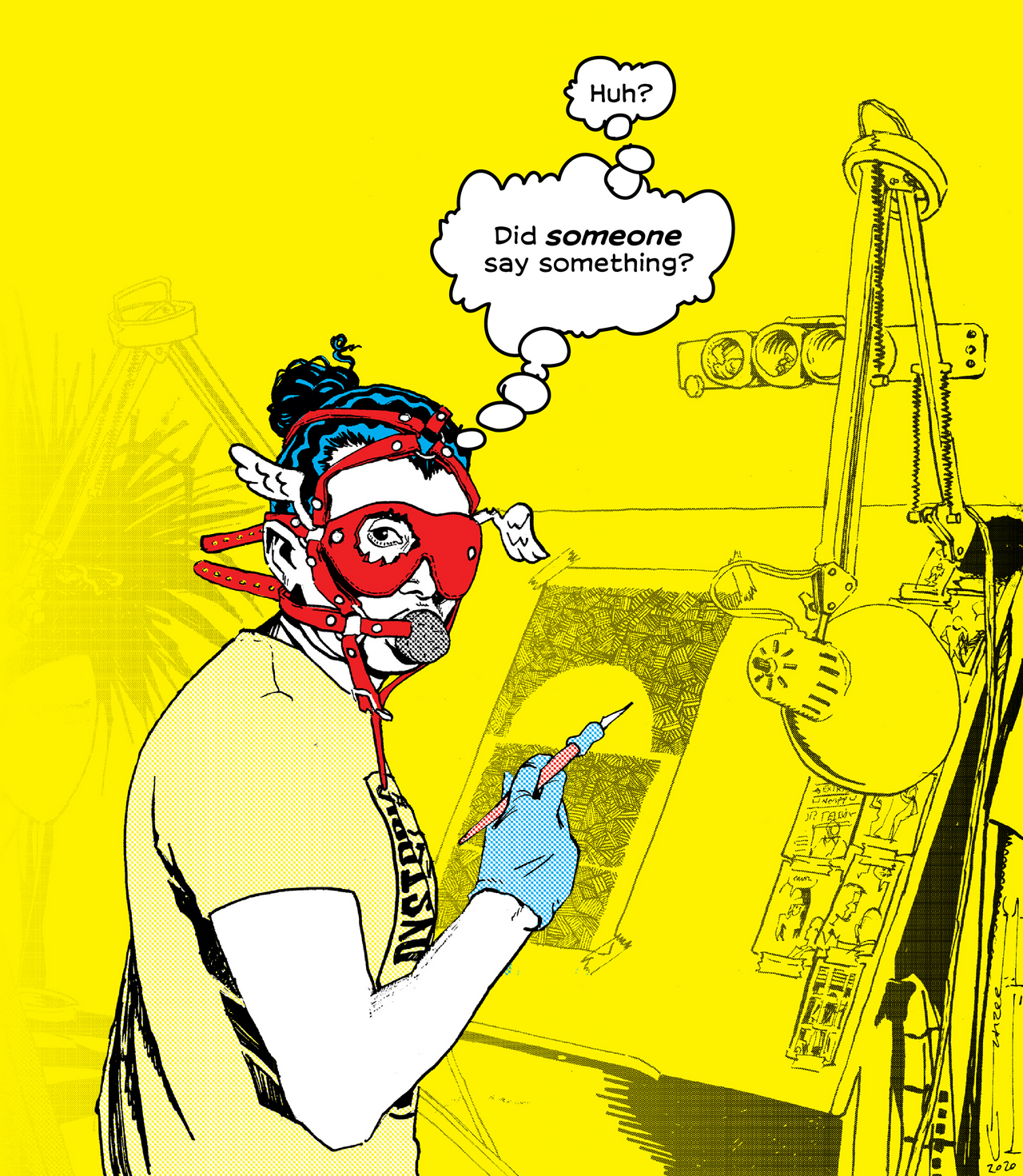
Mood:

But also: 💪

Above image, btw, is the cover art I did for new single from Ramy Essam, El Amiis El Karoo (“Flannel”), which you can find on Youtube and Spotify.

#journal #work

It's been a minute since I've found the time to journal, working round the clock on the art for an animated music video. The animation itself however will be done Paul MacLachlan, otherwise referred to as The Wizard for numerous legitimate reasons.

Also, I have another virtual talk coming up! This time for The Society of Illustrators together with Kickstarter's Oriana Leckert who graciously asked me to present with her on alternative comics' place at Kickstarter! December 8th the day and 6:00pm EST is the time. Don't miss it!

Work aside, the wife and I managed a short getaway to Austin over Thankstaking weekend, where we stayed in an utterly pleasant artist-run AirBnB. To enter the house, you have to walk through lush a greenhouse. There were many paintings of flowers and fauna, and chickens freely roamed the property.

A different kind of artist than myself or anyone I know. The kind that lives the way artists live in the imaginary when we think of the term “artist”. Apparently, she lives and thrives outside of the imaginary as well.

#journal #work

Tired of hiding all your explicit wall art when family and prudes drop in? Introducing HALAL PORNOGRAPHY, the third series in my reworked poster releases.

Abstract art and kink copulate in these sly works of concept pop, available as huge 12”x36” posters (roughly 61x91cm) only from Garage.Ganzeer.com

#Work #Art #Design

Having added this “murder wall” on a whim inside the lunar police captain's office (THE SOLAR GRID, Ch. 6), some function in the back of my head is now tinkering with the thought of a serial killer on the moon. This has no place in THE SOLAR GRID proper and there will be no mention of it, but if in the future I ever want to mess around with a detective procedural type thing, I may be enticed to set it on the moon in the world of THE SOLAR GRID. I wouldn't want the setting to be pointless dressing of a run-of-the-mill detective story though; it would have to be an integral part of the concept and tie in closely to notions of trade, migration, and imperialism (what with the Moon acting as a kind of port city in space within this particular world). One thing I hate about most detective stories is that they (knowingly or not) act vehicles of police propaganda, so I imagine I'd want to turn my story around and make it an indictment of policing instead.

Simple though, and not overly elaborate; a tight slim graphic novella. Then again, I've littered THE SOLAR GRID with so many little easter eggs that could all very easily warrant their own little graphic novella spanwlings.

This is perhaps where a regular magazine might come in.

There's a bit in the introduction to KALILA & DIMNA that does not mince words as to the work's approach, an approach that very much speaks to my own philosophy of Concept Pop: Wisdom enveloped within entertainment. The wise come unto it for the wisdom, and idiots come unto it for the fun.

And there's a bit in Thomas Mann's DEATH IN VENICE speaking to me in equal measure. The bit that describes Gustave Aschenbach's epic on the life of Frederick the Great (wherein both Gustave and his work are of course fictitious): “Outsiders might be pardoned for believing that his Maia world and the epic amplitude revealed by the life of Frederick were a manifestation of great power working under high pressure, that they came forth, as it were, all in one breath. It was more the triumph for his morale; for the truth was that they were heaped up to greatness in layer after layer, in long days of work, out of hundreds and hundreds of single inspirations; they owed their excellence, both of mass and detail, to one thing and one alone; that their creator could hold out for years under the strain of the same piece of work.”

It's been 5 years of THE SOLAR GRID to date. Hopefully not more than 1 more year to go. After which, I may need to indulge in a perverted masquerade or two.

Not in Venice necessarily.

#Journal #Work #Comix #TheSolarGrid

For the past couple of weeks now, I end my days without completely ticking off everything on my deck because my assessment of what I can handle has been a bit off. Today however is the first day in a while where I got all the things done and even added a couple more since I had the time. Squeezed in a short workout too, and whipped up a mean chicken fajita bowl for dinner. Life is good.

Pencils for THE SOLAR GRID Ch.6 are getting looser by the day (see above) as a result of having taken on multiple work-for-hire stuff this month. Which may not be a bad thing. It just leaves more room to actually draw stuff in the inking stage. Something I'm gonna need to account for when allotting time for it. Keeping inks till after I'm done with these other projects.

#Journal #Work #Comix #TheSolarGrid

Finally cracked open a copy of KALILA & DIMNA the wife scored for me on one of her many pre-COVID travels. Needed to get on a good reading kick before diving into this one, which MEN OF TOMORROW and MARVEL COMICS: THE UNTOLD STORY successfully supplied.

Before KALILA & DIMNA though, I'd initiated a read of THE PULPS by Tony Goodstone, deeming it a kind of unofficial prequel to both MEN OF TOMORROW and the MARVEL COMICS book; after all, America's two largest publishers of comicbooks did get their start as publishers of pulp magazines. After reading a couple of idiotically racist stories though, I had to put THE PULPS aside, with the resolve to read it intermittently rather in one continuous go. And thus my start on KALILA & DIMNA began.

KALILA & DIMNA is a collection of fables written sometime between 750-1250 AD. Actually, that's a lie. It precedes that, having been in the Persian cultural conscious for however long after having made its way there from India. The Arabic collection I now hold in my hands was adapted by Ibn Al Mokafaa', largely considered to be one of the most important Arabic authors in history despite his Persian origins—and as such, Arabic not being his mother tongue. The book comes with an extensive intro on Ibn Al Mokafaa', citing the importance of his contributions which can more or less be summarized in two points:

  • Introducing new uses and wordplay into the Arabic language inspired by his Farsi mother tongue.
  • Translating multiple books from Farsi into Arabic, including numerous books that were originally translated from other languages into Farsi, such as Indian and Greek; essentially introducing Arabic readers (and by proxy, speakers at large) to a wide array of knowledge from other cultures.

It also helps that Ibn Al Mokafaa' was by most accounts what you might call a, um, an infidel (possibly the reason behind his assassination); essentially injecting progressive thought into an otherwise conservative society. Then again, there was a lot of that happening at the time what with the Abbasid empire's rapid expansion and its embrace of a great many cultures in the process, one of the main reasons it is perversely (and ironically) pointed to as an “Islamic” golden age. ¯_(ツ)_/¯

This actually relates quite closely to a few things the MEN OF TOMORROW book got me thinking about, namely that you can probably relate any culture's “golden age” to an influx of immigrants or its exposure to and/or absorption of other cultures. Picture America without the contribution of its Jews, Mexicans, Greeks, Africans, Italians, Arabs, Japanese, Chinese, and Koreans... and what you're left with is awfully bland, isn't it?

#Journal #Reads

Huge congrats to Doctor Kelsey P. Norman's first book release, RELUCTANT RECEPTION from Cambridge University Press, for which I happily provided cover art and design.

Let's face it; academic books are notoriously fugly, even those put out by top university presses. A quick skim through any academic press's catalogue will aptly demonstrate such.

And if you zero in on any press's “middle eastern studies” department, you'll see that they are far from exempt of the clichés of American mass media; women in niqab abound, a close-up on an exotic Arab face, or perhaps crowds of angry or miserable looking brown people, or maybe... a photo of Islamic architecture, even if the subject matter has nothing whatsoever to do with architecture.

Honestly, clichés and stereotypes aside, it still wouldn't be so bad if the designs were actually good. Terrible typographic treatments and horrendous compositions are aplenty with academic books.

Not on my watch (Humblebrag without the humble 😎).

#Work #Design #Publication

Quick proof-of-life post to acknowledge my extended absence from blogging, and repent and make promises to return to daily posts even if I have to keep them super micro.

Hectic time, drawing pages for the 6th Chapter of THE SOLAR GRID as well as providing art for multiple music projects and activism campaigns alongside a number of podcast recordings. Not to mention administrative stuff and planning for future projects.

Let us not discuss the newborn.

On podcasts, here are links to my interview(s) with the CAIRO IN EXILE podcast, for which we recorded one in Arabic and one in English.

Aight, back to work.

#Journal #Press

Imagine zines —put together crude and fast by 19-28 year olds— given the kind of mass market distribution that only a giant like Condé Nast has access to. The more I read “Golden Age” comicbooks or read about them, the more evident it seems that that is exactly what they were, and it is exactly that that made them so successful.

Many “historians” simplify the birth of comicbooks by painting it as a natural evolution from comic-strips, neglecting the fact that the explosion of comicbooks differed from comic-strips not only in their length, or that they were entire publications dedicated to comics, but that they were incredibly crude, vulgar (even if intended for a younger audience), absurdly imaginative, and created for the most part by very young amateurs.

Chester Gould was 31 years old when he invented DICK TRACY for the newspaper strips. Hal Foster 45 when he started PRINCE VALIANT. Winsor McCay 36 when he launched LITTLE NEMO IN SLUMBERLAND. In contrast: When SUPERMAN hit the stands in ACTION COMICS #1? Siegel and Shuster were both 24 (but claimed to have invented Superman 3-6 years earlier). When BATMAN first appeared in DETECTIVE COMICS #27, Bob Kane was also 24, and his uncredited collaborated Bill Finger was 23. And over the course of their careers, both teams employed hordes of young eager teens, who not only executed the comics but drove many of the ideas within as well.

The comicbook gold rush that followed resulted in hundreds of publications produced by young energetic dudes relishing in outrageous ideas; Bill Everette was 22 when he came up with THE SUBMARINER. Don Rico and Jack Cole were 28 and 26 respectively when they invented DAREDEVIL for Silver Streak Comics (not the same as Marvel Comics' later character of the same name).

Unlike the comicstrips in the papers, these publications had little to no editorial oversight, and the artists behind them had little to no experience making the stuff. The publishers didn't even have editors at the time. What they did have was a salesman, accountant, and printer; resources they utilized to publish softcore porn and get it to as many newsstands, candy shops, and cigar stores as humanly possible. To be fair, they also produced fiction in the form of pulp magazines, but these weren't the mission-driven ones of Hugo Gernsack's early AMAZING STORIES. They were sensationalist drivel, their attraction revolving around shock, horror, and sexual suggestion. When they finally did decide to take on editors for the comics, the job predominantly entailed hunting down material to include in an ever expanding comics magazine empire. They weren't involved in pairing talent as is the case today, nor were they involved in the stories (for a time anyway). It was left up to the cartoonists to put together their own production teams, known at the time as packaging studios (a fancy term for a bunch of friends huddled in a room making fast comix). In short, hardly anyone involved knew anything about comix, most especially the publishers. What they did have was printing knowhow and a vast distribution network which they employed in the service of this new weird comicbook thing.

My point though is that there is powerful value in the uninhibited crude untrained imaginative output of the young. It may not contain anything near the level of craft of the established 30 or 40-something professionals, but it comes with a degree of unbound inventiveness that makes it incredibly awesome. Another thing Golden Age comicbook makers all had in common; the vast majority of them were the sons of Jewish immigrants.

Give a bunch of young immigrants (or the children of immigrants) a platform with mass reach, and watch the culture take huge unprecedented leaps.

Had I half a billion bucks in the bank, that's exactly what I'd do; publish zines by immigrants and their offspring with absolutely no editorial oversight and flood the market with those bad boys and watch society transform.

#ComixEngine

I'm done with normies.

That may sound cruel and snobbish as fuck, but the thing about normies is that they are inherently dumb and likely bigoted. Because normies are the ones who keep their head down and more than happy to live a pre-molded existence. They'll get a 9-5 at a respectable corporation, marry young, have kids, raise a family, want them to get into good schools without ever once questioning the status quo or attempting to imagine the possibility of a different world.

I mean, getting married and wanting good things for your kid(s) is fiiiiine obviously, but that doesn't have to come at the expense of opening your eyes to the world around you and challenging it. Press a normie hard enough (or not so hard really), and you're bound to hear an offhand comment about the homeless, protestors, or a particular sex, sexual orientation, or ethnic group.

Had the misfortune of hanging out with normies in the park yesterday (because any social interaction is a welcomed interaction right now, right?)—based entirely on our shared reality as new parents—and what a mistake that was. Life is too short to spend it with anyone who lacks the capacity to fuel your soul and/or intellect.

I'm done with normies.

Problem is: normies be everywhere. I may find myself slowly drifting into full reclusive shaman mode by the age of 40.

Not my idea of an ideal existence, but I'll take it over superficial social gatherings with normies.

#Journal

Enter your email to subscribe to updates.